Friday, March 30, 2007
The Georgia General Assembly meets for 40 days each year. The 30th day is "crossover day". That is, to be considered for passage into law, a bill must clear one chamber by that day. The remainder will be shelved until next year. The so-called "super-speeder" bill SB 125 passed. The key provision is as follows:
(b) In addition to any other fines or penalties imposed by any local jurisdiction or the department, the department shall administer and collect fees for the following traffic offenses:(1) Any driver who is convicted of driving at a speed of 85 miles per hour or more on any road or highway in Georgia or 75 miles per hour or more on any two-lane road or highway in Georgia, as defined in Code Section 40-6-187, shall be classified as a 'super speeder,' and a fee of $200.00 shall be imposed;
(2) Any driver who has his or her driver´s license or driving privileges suspended pursuant to the provisions of subparagraph (c)(1)(B) of Code Section 40-5-57 or suspended for points pursuant to the provisions of Code Section 40-5-57.1 shall, upon application for reinstatement, be subject to a fee of $100.00.
(3) Any driver who has his or her driver´s license or driving privileges suspended in whole or in part for a conviction for any of the traffic violations listed in this paragraph shall, upon application for reinstatement, be subject to a fee of $200.00. For purposes of this paragraph, 'traffic violations' means a conviction for any of the following offenses:(A) Racing under Code Section 40-6-186;(B) Leaving the scene of an accident under Code Section 40-6-270; or(C) Fleeing from or attempting to elude a police officer under Code Section 40-6-395.
(4) Any driver who has his or her driver´s license or driving privileges suspended and the suspension is partially based on a conviction for any of the traffic violations listed in this paragraph shall, upon application for reinstatement, be subject to a fee of $300.00. For purposes of this paragraph, 'traffic violations' means a conviction for any of the following offenses:(A) Driving a commercial vehicle with a blood alcohol concentration of 0.04 percent or greater under Code Section 40-5-151;(B) Driving under the influence under Code Section 40-6-391;(C) Feticide by vehicle under Code Section 40-6-393.1;(D) Homicide by vehicle under Code Section 40-6-393; or(E) Serious injury by vehicle under Code Section 40-6-394.
(5) Any driver who has been declared a 'habitual violator' pursuant to Code Section 40-5-58 shall be subject to a fee of $300.00, payable upon application for a regular driver´s license. This paragraph shall not alter the fines and penalties due upon application for a probationary license as provided for in Code Section 40-5-58.
(6) Any driver who accumulates:(A) Seven to nine points under Code Section 40-5-57 shall be subject to a $100.00 fee;(B) Ten to twelve points under Code Section 40-5-57 shall be subject to a $125.00 fee; or(C) Thirteen to fourteen points under Code Section 40-5-57 shall be subject to a $200.00 fee.
To what grand cause will this go to?
(f) All fees collected under the provisions of this Code section shall be deposited in the general fund of this state with the intent that these moneys be used to fund a trauma care system in Georgia and the direct and indirect costs associated with the administration of this Code section. The Office of Treasury and Fiscal Services shall separately account for all of the moneys received under the provisions of this Code section."
The CON laws will remain as is for now.
HB 337, a bill that would have defined general surgery as a single specialty did not pass the House.
The bill discussed in this post, SB 286 did not pass the Senate, so it seems tort reform is safe for another year.
Labels: Georgia, Tort reform, Trauma System Development
|Wednesday, March 21, 2007
Be warned, an ill rant follows.
While no serious threat to tort reform is forthcoming from the Georgia General Assembly this year, some small efforts are being made. An article in today's Macon Telegraph tells the plight of one who is thought to be a "victim" of tort reform: State senators try to retool immunity to ER docs:
Families like the Fretwells seem to be forgotten in the annual turf war between doctors and lawyers in Georgia's Capitol about who should be protected from malpractice lawsuits.
Like others, Rodney and Sherry Fretwell paid scant attention to the state tort reforms approved two years ago, worrying instead about making their next house payment, keeping food on the table and making sure their two young daughters were happy and safe.
But they were soon confronted with one of the least-known provisions of the 2005 law, an obscure section that makes it nearly impossible for patients to win medical malpractice lawsuits against emergency room doctors. Now their story, and others, has prompted Georgia lawmakers to propose retooling the laws and make it easier for alleged malpractice victims to make their case in court.
It started in February of last year, when Sherry insisted that her 39-year-old husband go to the Columbus Medical Center's emergency room so doctors could treat a headache that wouldn't go away after four days and numbness on the left side of his body began to grow.
A doctor there told the burly builder that the problem was likely a pulled muscle, and sent him home with prescriptions for a muscle relaxer and blood pressure medicine.
Within a few hours, Fretwell said his left side was paralyzed. He rushed back to the hospital, but the same physician told him once more he suspected a pulled muscle and sent Fretwell home.
The next morning, he was back - this time, by ambulance. His vision had blurred and his vomiting grew worse overnight. After tests, doctors confirmed he had suffered a stroke.
A month later, the family sought out a lawyer to see if they could sue. They were told if the doctors had originally diagnosed a stroke, they could have treated him with medication to reduce its severity. But the lawyers also said the new state law gives emergency room almost complete immunity from malpractice lawsuits, making a lawsuit a long shot.
Were Mr. Fretwell's physicians negligent? I don't know.
Was Mr. Fretwell an candidate for thrombolysis? I don't know.
If he had received it, would it have made a difference? I don't know.
I also don't know the hospital or physician's side of the story. And unless a suit is filed, I never will. But becuase of privacy rules these allegations are out there and unchallenged. Did the reporter call the hospital for comment? While the hospital may have been unable to do so because of privacy regulations, the reporter could have done so in the interest of fairness. Why is that important? Because such tragic stories attract the attention of those in power:
That could soon change. A bipartisan group of lawmakers, including Republican Senate Majority Leader Tommie Williams, R-Lyons, and Democratic Senate Minority Leader Robert Brown, D-Macon, say they fear the provision goes too far. They back a measure that would scrap language requiring patients to prove emergency room doctors acted with "gross negligence" in malpractice cases, a standard that forces lawyers to prove they knowingly mistreated the patients.These same elected officials engage in some clever re-branding of the proposal:
The influential group's opposition to the changes is giving the proposal's supporters fits. Republican Sen. Seth Harp, the bill's sponsor, has taken to calling the measure "the physician's protection bill" to smooth over legislators who fear butting heads with the medical association.Now if that is the case, it's the first I've heard of it. This coming from the senator who voted for the bill because "I was beat, plain and simple. . . . There's no point in riding a dead horse." Who are these physicians who can't get coverage because of the "fuzzy" standard?
He says that the "gross negligent" standard is so fuzzy that malpractice insurers are refusing to cover some ER doctors.
"It's a misfortune," says Harp, a Republican from Midland, a few miles from where the Fretwell family lives. "They're not protecting physicians and we're trying to make sure they have that coverage." The legislation faces a series of hurdles before it reaches a vote, which is why Rodney Fretwell wants legislators to know his story.
The law not only affects EM physicians, but anyone who provides care under these circumstances. The relevant section of the law is as follows:
In an action involving a health care liability claim arising out of the provision of emergency medical care in a hospital emergency department or obstetrical unit or in a surgical suite immediately following the evaluation or treatment of a patient in a hospital emergency department, no physician or health care provider shall be held liable unless it is proven by clear and convincing evidence that the physician or health care provider´s actions showed gross negligence.Now what brought his article to my attention was this post at Peach Pundit in which the author states that "the legislature was intent on punishing GATL members than improving the conditions in the state."
I disgagree with that assumption. This provision was designed to soften the EMTALA trap. For those not in the medical field EMTALA stands for the Emergency Medical Treatment and Active Labor Act,or the largest unfunded mandate put forth by the federal government. The trap that requires physicians to provide emergency care to individuals without regard for the ability to pay. As my handful of readers know, EMTALA does not provide any shield of immunity for physicians. So physicians are forced to take on full liability, with no guarantee of payment.
Others have discussed the problems with EMTALA, and others have discussed the tax relief legislation that has been proposed. I myself am in favor of a system in which physicians providing care required by law under EMTALA are immunized like any other government physician.
Labels: EMTALA, Georgia, Tort reform
|Tuesday, January 16, 2007
From Peach Pundit and the Macon Telegraph comes the latest on the funding for the long-overdue state-wide trauma system. Some advice: slow down.
The push is on to find new sources of revenue to improve the state's trauma network, and it may lead to big new fines for speeders.Mr. O'Neal's brother, BTW, is the State EMS Medical Director here in Georgia. Dr. O'Neal has done a fine job here in Georgia and has been a tireless advocate for trauma system development here in Georgia.
Gov. Sonny Perdue has announced a plan to tack on "additional, substantial fines" for so-called "superspeeders," Perdue press secretary Bert Brantley said. That money would be used to improve emergency care in rural Georgia and give a boost to hospitals that lose money caring for severely injured people.
Other ideas to fund improvements are also percolating at the Capitol, and a finished bill - or bills - may be weeks away from debate. The governor's office hasn't set the amount of the new fine, but Brantley said it would be "potentially in the hundreds of dollars."
Two midstate lawmakers are heavily involved in the process, having co-chaired a study group on trauma-care issues this summer.
State Sen. Cecil Staton, R-Macon, and state Rep. Larry O'Neal, R-Warner Robins, said Perdue's plan will have to be discussed. Both men are working on bills to create a permanent commission to manage funds set aside for improvements and keep an eye on the issue after it fades from the limelight of this General Assembly session.
The problem:
The problem is the need to quickly treat severely injured people - and the high cost of doing so. Surgeons must be kept on call, expensive equipment must be on hand, and the injured person must be transported quickly.
That's difficult, particularly in rural Georgia, where there are large gaps in the state's network of hospitals equipped to handle the most serious injuries. In fact, the study group found that Georgia's trauma death rate is 20 percent above the national average - a difference of about 700 lives a year.
Money is a big part of the reason. Of the state's 152 acute-care hospitals, 15 are designated trauma centers. And four - in Macon, Atlanta, Augusta and Savannah - offer the highest level of care, the report states. Many hospitals don't offer these services, in part, because of a high level of uninsured patients seeking care, the report states.
Doctors, hospitals and EMS services lose about $250 million a year on trauma care, the report states. The Medical Center of Central Georgia in Macon has complained of this in the past, saying shortfalls could lead the hospital to drop its level of care.
The devil, as always, is in the details:
The answer, according to several legislators, is to develop a new pool of money to establish new trauma centers, keep the current ones solvent and purchase more helicopters to quickly transport accident victims, who would receive free transport.
Increasing speeding fines would require a constitutional amendment, which in turn would require a statewide referendum, O'Neal said. O'Neal said he would probably support increased fines for "superspeeders," but to expect intense debate over just what that means.
For the moment, the governor's office has defined a "superspeeder" as anyone who drives faster than 85 mph, or 75 mph on a two-lane road, Brantley said. The governor's proposal also targets habitual violators who lose their driver's license and would pay a heavier fine when they reapply for the license, Brantley said.
Staton said he's glad to have the governor on board, but both he and the governor's office agree that new fines might not raise enough money. Projections have put the initial cost of the trauma network need at $85 million, with a lower cost recurring each year.
The study group's report also listed several funding options besides new traffic fines, including:
• Diverting a portion of the Georgia insurance premium tax.
• A $5 surcharge on motor vehicle registrations.
• A $1.16 monthly surcharge on cell phones.
• Surcharges on rental and leased cars.
• An option on Georgia tax forms allowing people to donate a portion of their tax refund to the trauma care fund.
Because the changes would also help prepare the state for a large-scale disaster, O'Neal said he's hoping federal money will be available through homeland security grants.
The ball is rolling on the issue, and there seems to be enough support to make significant changes, Staton said.
The question is "what the numbers will ultimately be," he said.
Between this and CON, it makes for an interesting session.
Labels: Georgia, Trauma System Development
|Monday, January 15, 2007
From the Journal-Constitution:Athens medical school just what the doc ordered
Forty medical school students will begin attending a joint University of Georgia and Medical College of Georgia campus in Athens in 2009, paving the way for a new health science complex at the state's flagship university, UGA president Michael Adams said this week.
Adams, who gave a State of the University address Thursday, said Friday the collaboration could eventually put as many as 200 medical students in Athens, but he stopped short of saying UGA planned to develop its own medical college.
"What we proposed was a joint trial period," working with Medical College of Georgia, he said. "Nobody has committed to anything beyond that."
The site would be at the soon-to-be vacated Navy Supply Corps School located on some prime real estate in Athens. The site is adjacent to Athens Regional Medical Center.
Faculty members from both UGA and MCG will teach at the medical school, which MCG President Daniel Rahn described as a regional campus for the Augusta-based college.
In the past year, MCG has increased enrollment of first-year students from 180 to 190. Adding another 40 students a year in Athens beyond that number will help combat statewide and national physician shortages, he said.
The Association of American Medical Colleges has called for increasing enrollment of medical students by 30 percent by the year 2015 through expanding existing schools and creating new ones. After 20 years of no growth in the number of medical schools, several states, including Florida and Texas, are now building new ones.
Rahn said the Athens campus will be accredited and will use MCG's existing curriculum.
MCG has already done this with its' nursing school. There is some talk of one day setting up an independant medical school at the Athens site:
While no one is speculating publicly on whether the project could morph into a full-scale UGA medical school, the university has been placing an increasing emphasis on healthcare and research. In 2005, UGA opened a College of Public Health and a major center for biomedical and health sciences, and it has been ramping upThere has also been an Osteopathic school opened recently in Georgia.
the university has been placing an increasing emphasis on healthcare and research. In 2005, UGA opened a College of Public Health and a major center for biomedical and health sciences, and it has been ramping up bids for national research dollars. UGA and MCG already have partnerships in nursing and pharmacy programs.
Adams said, of the 10 largest states, Georgia is the only one without three public medical colleges. Currently, Medical College of Georgia is the state's only public medical school. Emory University, Mercer University and Morehouse College run private medical schools.
Labels: Georgia, MCG, medical education, UGA
|Monday, January 08, 2007
The Georgia General Assembly kicks off today and tort refrom is not the only health-related subject that is up for debate this year. I saw this post from Peach Pundit about the upcoming battle over Certificate of Need (CON) in Georgia a few weks ago and was moved to comment, given the impact that CON will have this year.
For those unfamiliar, a CON is a permit that hospitals and other healthcare institutions must aquire before construction of facilities (even non-medical ones, such as a parking deck) or offer a new service (such as cardiac surgery).
The rationale from the State of Georgia's .Certificate of Need Frequently Asked Questions Review Guide:
Georgia’s Certificate of Need Program was codified by the Georgia legislature in 1979 in Georgia's Health Planning Statute, Title 31, Chapter 6. The purpose of the CON program is to insure the availability of adequate health care services to meet the need of all Georgians, while safeguarding against the unnecessary duplication of services that perpetuate the costs of healthcare services. The Department of Community Health was created in 1999 and the administration of the CON Program was placed within the Department.
There are some projects that are exempt from the CON process:
An Ambulatory Surgery Facility that is physician owned, office-based, and single-specialty, the establishment and development of which does not exceed the limited-purpose physician-owned ambulatory surgery centers threshold.According to the footnote the 2004 figure was $1,436,356. The key term above is "single specialty", a term that has generated some controversey.
What has brought this to the forefront was our old friend Dr. Bagnato. Word around the campfire became that Dr. Bagnato's suggested motivation for his lawsuit was Pheobe Putney's opposition to his CON for an ambulatory surgery center. The wrinkle here is that in the state of Georgia general surgery is not considered a single specialty so Dr. Bagnato was not allowed to avoid the CON process.
Dr. Bagnato has found a voice in the Georgia Society of General Surgeons, a group that has been fighting to change the CON laws since its' inception. (Full disclosure, I am not a menber) While I can understand their frustration I do not agree with their reasoning or the protrayal of hospitals.
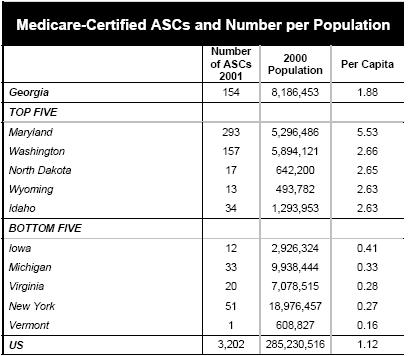
I will be the first to admit my take is skewed by my role in the trauma program in River City, so caveat empetor. I have seen plastic surgeons, ortopedic surgeons, urologists and otolaryngologists stop taking trauma and emergency call because they can do the vast majority of their procedures in office or an ambulatory surgery center (ASC) and not rely on the hospital. EMTALA also places a burden on hospitals (and physicians) that are not shared by the ASC or office-based surgery suites. And despite what may be said, medicine in 2007 is not a free-market system, and the usual rules of supply and demand do not apply. There is some irony that the GSGS supports a statewide trauma network, but is making it more difficult to obtain the coverage needed to make it work (as does the Medical Association of Georgia). We certainly don't lack for ASC's in Georgia as this chart shows we have above the national average per captia number of ASC's:
But the reccommendations are out. For those who wish to read the entire 267 pages of the report, here you go. But for the easily bored, here are the reccommendations from the executive summary that pertain to general surgery and ASC's:
Recommendation 14.1 (5 Agree, 1 Disagrees, 4 AbstainOn this Dr. Bagnato and I agree. Treat us the same as our orthopedic, urologic, and otolayngologic peers.
Treat General Surgery in a consistent manner as all other single specialties.)
The majority of the Commission recommends that General Surgery be treated in a manner consistent with all other singe specialties, regardless of the regulatory requirement for single specialty facilities.
One member disagrees and maintains that general surgery should be treated as a multi-specialty because of the complex nature of the cases that a general surgeon may perform.
Recommendation 14.2 (5 Agree, 3 Disagree, 2 Abstain)This would allow for ASC's to be built on every street corner if so desired, since need criteria would not be factored into a CON decision. Physicians who utilize an ASC would be required to maintain hospital staff priveledges and take ED call. Another objection, in addition to those described above, is that this would allow hospitals an unfair advantage since if a physician were to resign or be removed from staff, theit CON could be affected. Then there is an absolutist position:
Abolish entirely the exemption for freestanding single specialty, office-based, physician-owned ambulatory surgery centers and require physician-owned limited purpose ambulatory surgery centers to obtain a Certificate from the Department. Upon application, such applicants would not be required to address need criteria but would be required to make indigent and charity care commitments, to accept Medicaid, to supply data to the Department of Community Health, and to verify that all its physicians are members of a hospital staff and are willing to accept emergency room coverage.
The membership of the Commission was sharply divided on the issue of physician-owned single specialty ambulatory surgery centers, which are currently exempt from Certificate of Need if the center can be established for a dollar amount less than approximately $1.6 million. One contingent of the Commission agrees with the recommendation that the current exemption be abolished and that limited-purpose, physician- owned ambulatory surgery centers (“ASC”) obtain a Certificate, although such centers would be free from an objective need methodology. Such ASCs would be required to commit to the provision of indigent and charity care at a level of 3 percent of adjusted gross revenues. In addition, this contingent recommends that these ASCs agree to accept Medicaid, if at all possible, and provide services as a minimum community standard, that such facilities agree to provide annual data to the Department, and that all physicians who perform procedures at the facility be required to hold hospital staff privileges, if possible, and to accept ER coverage. The members who agree with this recommendation do so because freestanding single-specialty ambulatory surgery centers have been shown to be high quality and low cost alternatives. These members who argue for less regulatory control contend that to artificially restrain these services raises costs reduces efficiency, and prevents physicians from billing facility fees.
Other members disagreed with this recommendation and maintain that the exemption for physician-owned ambulatory surgery centers should be abolished and that such centers should be required to obtain a Certificate of Need addressing all applicable review criteria including a determination of need. These members are concerned that if ambulatory surgery centers are allowed to proliferate significantly, hospitals will not have a financially sustainable business model. Mainly, these members maintain that ambulatory surgery centers take low acuity, paying patients, and leave hospitals to treat the complex cases and individuals without the ability to pay.
The CON Commission has been unable to reach consensus with regard to the best policy to address this difficult issue because its root causes involve complex factors relating to reimbursement and costs that are beyond the CON program’s purview. A real and sustainable solution to this dilemma will require a health policy approach that corrects the cost and payment problems for both professional services and hospital-based services, particularly with respect to the under-insured and uninsured.
Recommendation 14.3 (3 Agree, 3 Disagree, 4 Abstain)As an aside, what's with the abstentions? the Chair and vice-chair and another member (Dr. Meadows) were ex officio members of the committee (probably due to their being state employees) but the report states that on the ASC subject they did vote. The report makes no mention of how each member voted or why those that abstained did so (I have this information but cannot confirm it). Given the high stakes involved I believe that some weaseled out of making a commitment. A few other reccommendations of note that do not relate to surgery, but may have a higher impact:
Abolish the exemption for physician-owned, office-based, single specialty ambulatory surgery centers and require such facilities to obtain a Certificate of Need under the exact same standards as all other ambulatory surgery centers.
The original recommendation of the Specialized Services Sub-Committee was to abolish the current ASC exemption and require all ASCs to obtain a Certificate of Need without exception. The full Commission discussed this recommendation, but was sharply divided and no final conclusion was reached on the recommendation.
and....
Recommendation 6.0 (4 Agree, 1 Disagrees, 5 Abstain)
Deregulate diagnostic cardiac catheterization and require therapeutic catheterizations to be performed only by providers approved to offer open heart surgery.
The members of the Commission who support the deregulation of adult diagnostic cardiac catheterization maintain that deregulating diagnostic cardiac catheterization will allow for the proliferation of these services in the market assuring access to residents in all areas of the state. Such members feel that this service is a valuable service to the citizens of the state and has been shown to save lives, particularly in states such as Georgia with high rates of coronary disease. These members feel that the regulation of the quality of this service could be managed by Licensure.
One member of the Commission disagrees. This member feels that this service should continue to be regulated by Certificate of Need. Because cardiac catheterization is such a specialized service, certain quality standards must be met to achieve the best possible outcomes. Because the American College of Cardiology recommends that minimum volumes be maintained to ensure the quality of the service, this member feels the Certificate of Need process ensures that there will not be a proliferation of low volume providers who won’t maintain the same quality as high volume providers.
Several members of the Commission report that this recommendation should only apply to hospital-based cardiac catheterization and not to freestanding cath programs.
Recommendation 7.0 (6 Agree, 1 Disagrees, 3 Abstain)The hospitals are already planning their next move:
Deregulate Level I perinatal services and continue regulation of Level II and Neonatal Intensive Care.
Most members of the Commission recommend that Level I perinatal services be deregulated because these services are already provided by most hospitals in the state and do not require specialized labor. These members believe that access to perinatal and obstetrical care will be enhanced by their recommendation. The fact that federal law already requires a facility to treat a woman in active labor further supports this recommendation. The members who make this recommendation maintain that Level II and Level III services should continue to be regulated by CON because of the highly- skilled nature of these services and the workforce that is required to support them. One member of this group further believed that Level II should be deregulated in addition to Level I.
One member of the Commission made the recommendation to maintain existing CON regulation for this service. This member believes that maintaining Certificate of Need regulation of Level I perinatal services will address the problem of large fixed costs incurred by facilities that provide these services and the shortage of skilled workforce.
Several members of the Commission report that this recommendation should be limited to Level 1 perinatal services at hospitals and should not be construed as a recommendation regarding freestanding facilities.
Concerned about a possible hit to their bottom line, metro Atlanta hospitals are preparing to put a few newly proposed state health-care regulations under the knife.
.....Hospitals argue that physician-owned surgery centers siphon off their best-paying patients, leaving the burden of the uninsured for hospitals to bear.
Recent financial data just released by the state Department of Community Health, which tracks the performance of hospitals each year, shows that metro Atlanta's 25 largest hospitals spent nearly $485 million combined on uncompensated, indigent and charity care in 2005. That's up 12 percent from $435 million in 2004.
The recommendation "is just one more knife in the hospitals' back, and it's a big knife," said Michael Rovinsky, president of the health-care consulting firm Integrity Consulting Group. "General surgery accounts for a lot of profitable procedures. This is the one [recommendation] that's going to be fought the hardest."
....But the proposal to classify general surgery as a single specialty could be damaging to many hospitals, especially as they continue to fight rising costs to care for the poor and uninsured.
"It would have a financial impact," said Holly Snow, Piedmont's vice president of government and external affairs.
The commission anticipated the controversy, and in its recommendations says all outpatient surgery centers must commit to serving the indigent and uninsured.
Other possibly contentious recommendations are also included in the commission report. One permits hospitals wanting to launch general labor and delivery programs to circumvent the certificate-of-need process. The same goes for hospitals trying to start up diagnostic heart catheterization programs. The catheterization procedure involves a thin, hollow tube that is threaded through the body to examine the heart's chambers.
My physician colleagues need to tread carefully here. The hospitals can make a very persuasive argument aimed at the public concerning lack of access to care. If left to their own devices I doubt many of these ASC's will take care of the medically complex or the underinsured. It will be an interesting battle.
Labels: Georgia
|


